

The Family and Medical Leave Act gives eligible employees up to 12 weeks of unpaid, job-protected leave each year for their own serious health condition, for a new child, or to care for a family member. Employers have real obligations under it, including giving timely and accurate notice, keeping group health coverage in place, and putting the employee back in the same position or an equivalent job when they return. Knowing where those duties sit is what lets you spot the moment your employer crosses the line.
Westview Law PC acts for employees, never for the companies that employ them. Taylor Markey clerked at the Ninth Circuit and the California Court of Appeal before serving as an Assistant Regional Attorney at the U.S. Equal Employment Opportunity Commission, where she led systemic discrimination litigation. Founder David Safvati clerked at the Los Angeles Superior Court and now runs a trial practice that earned a place on Best of the Bar’s Top 100 Verdicts in California in 2024. If your employer denied your leave request or punished you for taking it, contact us today for a free consultation.
This blog covers the most common FMLA violations by employers, how to prove one, the steps to take if you suspect it, what these violations really cost, and how an attorney can help.
What Are the Common FMLA Violations by Employers?

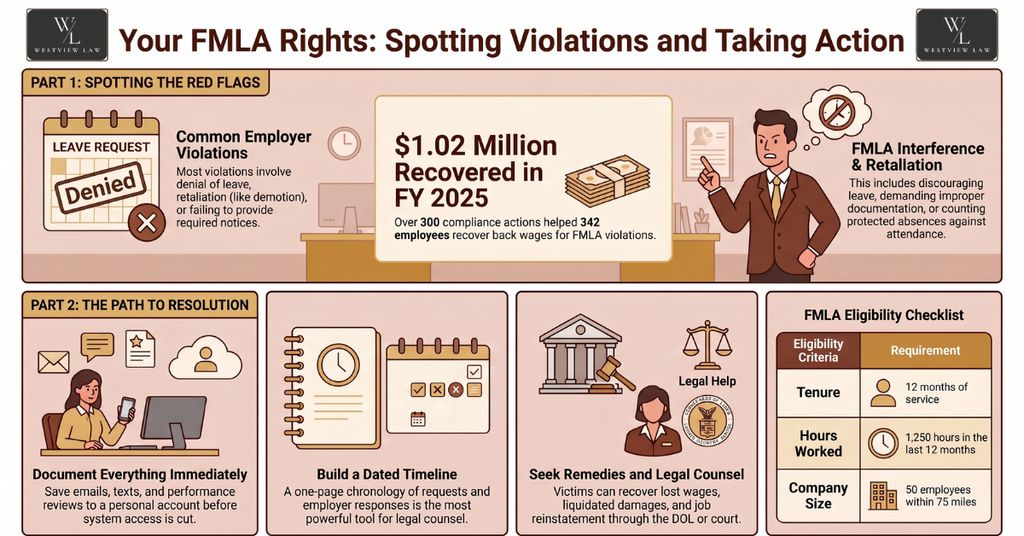
The U.S. Department of Labor recorded 301 FMLA compliance actions involving violations in fiscal year 2025. Those cases affected 342 employees and resulted in more than $1.02 million in back wages. Denial of leave was the most frequently recorded violation, appearing in 116 cases, followed by discrimination or disciplinary action in 106 cases and failure to reinstate employees in 84 cases.
Most FMLA violations are not dramatic. They often look like a missed notice, pressure from a manager, or a return to work that quietly puts you in a worse position. Four common patterns come up again and again.
1. Failing to Notify Employees of Their Rights
Covered employers must provide employees with specific FMLA notices. After an employee requests leave, or the employer learns the leave may qualify, the employer generally has five business days to provide an eligibility notice, followed by the required rights and responsibilities and designation notices. Failing to provide these notices can prevent employees from understanding their FMLA rights and may constitute unlawful interference.
2. Interference With FMLA Leave
FMLA interference includes more than simply denying a valid leave request. An employer may violate the law by discouraging an employee from taking FMLA leave, questioning legitimate intermittent leave, demanding improper medical documentation, or unreasonably delaying a leave decision. Even comments about staffing problems or pressure to use vacation instead of FMLA leave can be evidence of interference when they discourage an employee from exercising FMLA rights.
3. Retaliation Against Employees
FMLA retaliation occurs when an employer takes adverse action because an employee exercised or attempted to exercise FMLA rights. This can include termination, demotion, discipline, unfavorable scheduling, or treating FMLA leave as a negative factor in promotion decisions. Employers also generally cannot count protected FMLA absences under a neutral attendance policy in a way that penalizes an employee for taking protected leave.
4. Misclassification of Employees
Some FMLA disputes begin when an employer incorrectly determines that an employee is not eligible for leave. Generally, an employee must have worked for the employer for at least 12 months, worked at least 1,250 hours during the preceding 12 months, and worked at a location where the employer has at least 50 employees within 75 miles. Employers may also misunderstand what qualifies as a serious health condition, which can include inpatient care, continuing treatment, chronic conditions, pregnancy and prenatal care, and certain long-term conditions.
FMLA Violation vs. What It Means for You
Not every FMLA dispute looks the same. The difference between a notice failure, interference, retaliation, and an eligibility mistake can affect what you need to prove and what evidence may support your claim. Use the comparison below as a starting point for identifying where your situation may fit.
| Potential Violation | What It Means | What to Document | Why It Matters |
|---|---|---|---|
| No required FMLA notice | Your employer may have failed to properly explain your eligibility, rights, responsibilities, or whether your leave counted as FMLA leave. | Leave request, HR emails, notices received, certification documents | Missing notices can interfere with your ability to understand and exercise your FMLA rights. |
| Leave denied or discouraged | Your employer may have interfered with your right to take qualifying FMLA leave. | Leave requests, manager comments, HR communications, medical certification | Evidence showing you were discouraged or prevented from taking protected leave can support an interference claim. |
| Punishment after taking leave | Discipline, termination, demotion, or other adverse treatment may constitute FMLA retaliation if connected to your protected activity. | Performance reviews, disciplinary records, termination letter, emails, timeline | Timing and changes in the employer's explanation can help show whether leave played a role in the decision. |
| Protected absences counted against you | Your employer may have improperly treated FMLA-protected absences as attendance violations. | Attendance records, FMLA approval, attendance policy, warnings | These records can show whether protected leave was improperly used as a basis for discipline or termination. |
| Incorrect eligibility decision | Your employer may have incorrectly determined that you did not qualify for FMLA protection. | Employment history, hours worked, worksite information, medical records | Eligibility depends on specific federal requirements, so an employer's initial decision may not be the final word. |
| Failure to restore you after leave | You may have been denied the required return to the same or an equivalent position after protected leave. | Pre- and post-leave job descriptions, pay records, schedules, employer communications | Comparing your position before and after leave can help identify whether your restoration rights were violated. |
How to Prove an FMLA Violation
FMLA protections affect a substantial share of the U.S. workforce. A U.S. Department of Labor survey found that 56% of U.S. employees were eligible for FMLA leave based on their reported tenure, hours worked, and worksite size.
Documentation wins these cases, and the employee who starts keeping records early is in a completely different position from the one who starts after the termination. Save every email and text about your leave request, the certification you submitted, the date you handed it over, and any notice the employer gave you or failed to give you. Write down conversations too, with dates and names, because a manager’s offhand comment about your absences rarely appears in writing anywhere else.
Denied requests and disciplinary actions deserve their own file. Keep the denial itself, whatever reason the employer gave, and any version of that reason that changed later. Keep your performance reviews from before the leave, because the comparison against what came afterward is often the clearest thing a lawyer can put in front of a judge.
The legal standards differ depending on what happened. An interference claim asks whether you were entitled to an FMLA benefit and whether the employer denied it, and your employer’s intent is largely beside the point.
A retaliation claim asks whether the employer took adverse action because you exercised your rights, which puts motive squarely in issue. Both start with the same three building blocks: you were eligible, you were entitled to leave, and something happened that should not have.
Direct evidence is rare, so most cases are built from circumstantial evidence. Timing matters, particularly where discipline lands close to the leave request. So do shifting explanations, policies applied to you and nobody else, and a paper trail that starts only after you asked for leave.
What Are the Steps to Take if You Suspect an FMLA Violation?

If you suspect your employer violated your FMLA rights, taking the right steps can help you protect your position and document what happened. Start by gathering the relevant records and identifying how your employer's actions may have affected your leave, job, or benefits. If your FMLA rights have been violated, the following steps walk you through what to document, where to raise the issue, and when to consider legal help.
Step 1: Confirm You Were Actually Eligible
Check your months of service, your hours worked in the last 12 months, and whether your worksite has 50 employees within 75 miles. Getting this straight first tells you whether you are looking at an FMLA violation or a different problem entirely.
Step 2: Identify What the Employer Did or Failed to Do
Match the facts to a category: no notice, a denied or discouraged leave request, retaliation after you returned, or a wrong eligibility call. Naming the violation shapes everything you do next.
Step 3: Gather Your Records Now, Not Later
Pull emails, texts, schedules, pay stubs, medical certifications, and every notice you received, and move them to a personal account rather than a work device. Employers cut off system access on the day they terminate someone.
Step 4: Build a Dated Timeline
Write down when you requested leave, who you told, what they said, and every change that followed. A one-page chronology does more work in a first consultation than a box of documents.
Step 5: Raise It With Your Employer in Writing
Report the problem to HR or your manager by email so a timestamp exists, keep it factual, and say what you want fixed. Plenty of violations come from a manager who does not know the rules, and a written complaint sometimes solves it outright.
Step 6: File With the Wage and Hour Division if That Goes Nowhere
The U.S. Department of Labor’s Wage and Hour Division takes FMLA complaints and can investigate and work to compel compliance. Filing there does not stop you from going to court, and you do not need to exhaust it first.
Step 7: Understand the Remedies Before You Decide Anything
The FMLA allows recovery of wages, salary, benefits, and other compensation you lost, or where you lost no wages, actual monetary losses such as the cost of care up to 12 weeks of pay. Courts can add liquidated damages equal to that amount plus interest unless the employer proves it acted in good faith, order equitable relief, including reinstatement and promotion, and award attorney’s fees and costs.
Step 8: Talk to an Employment Attorney, and Watch the Clock
An FMLA action generally has to be brought within two years of the last event, stretched to three years for a willful violation. Speak to a lawyer well before that, because evidence goes stale long before the deadline does.
What Are the Hidden Costs of FMLA Violations by Employers?
The direct penalties are the part employers see coming. Lost wages and benefits, liquidated damages that can double the award, interest, reinstatement, and the employee’s attorney’s fees on top. For a company that denied one leave request to cover a busy quarter, the arithmetic rarely works out in its favor.
The reputational cost lands harder and lasts longer. Employees talk, and a company known for fighting leave requests finds hiring slower and offers declined more often. In California, the exposure is broader still, because the California Family Rights Act covers employers with five or more employees, so a business too small for the FMLA can still be on the hook under state law.
Morale takes the hit nobody puts on a balance sheet. Watch a colleague get punished for taking approved leave, and you learn what happens to people who ask. Requests stop coming through official channels, people work through conditions they should be treating, and the workforce quietly stops trusting the process. Productivity follows morale down, and retention follows both.
For employees, the protection is practical rather than legal. Put leave requests in writing. Keep your own copies of every certification and notice. Read the designation notice when it arrives and query it if the numbers look wrong. And get advice early rather than after the termination, which is where Westview Law PC does most of its useful work, telling people what their rights actually are while there is still time to enforce them.
How Can an Attorney Help if Your FMLA Rights Have Been Violated?
In California, you usually have two sets of rights running at once. The FMLA is federal, and the California Family Rights Act sits alongside it with a much lower threshold at five employees, plus separate protections for pregnancy disability leave. An employment attorney works out which laws apply to your situation, which gives you the strongest claim, and which deadline is running, because federal and state clocks do not match.
From there the work is practical. A lawyer reads the certifications and notices to see whether the employer met its obligations, sends preservation demands before records disappear, handles the correspondence so you are not negotiating with your own HR department, and decides whether the claim belongs at the Wage and Hour Division, the Civil Rights Department, or in court.
Here is how that plays out. Imagine Elena, a scheduler at a logistics company outside Los Angeles, who takes intermittent FMLA leave for a chronic condition that flares up a few days each month. Her employer never sends a designation notice, then starts counting those days as unexcused absences under its attendance policy. Six weeks later she is terminated for attendance. Elena brings her certification, her emails requesting leave, her attendance records, and three years of positive reviews to Westview Law PC.
The firm identifies both the notice failure and the attendance-policy misuse, preserves the records, and pursues the claim on her behalf. This scenario is illustrative and is not based on a specific Westview Law client matter.
Has Your Employer Violated Your FMLA Rights?
Covered employers owe you timely and accurate notice. They cannot deny or discourage leave you are entitled to, they cannot punish you for taking it, and they have to restore you to the same position or an equivalent one. The most common FMLA violations are missed notices, interference with a leave request, retaliation after a return, and a botched eligibility call.
Proving it comes down to documentation, timing, and the employer’s own shifting explanations. If any of this describes your job, get advice from an employment attorney before the deadline runs.
Westview Law PC represents employees throughout California from its Century City office, and a case review costs nothing. Founder David Safvati clerked at the Los Angeles Superior Court and now runs a trial practice that earned a place on Best of the Bar’s Top 100 Verdicts in California in 2024. Bring your timeline, your certification, and whatever notices you received, and you will know where you stand. Contact us today.
Frequently Asked Questions
These are common questions from employees who believe their employer mishandled their leave. The Family and Medical Leave Act (FMLA) provides eligible employees with job-protected, generally unpaid leave for qualifying medical and family reasons.
How Can Employees Report FMLA Violations by Their Employers?
Employees can report suspected violations to the U.S. Department of Labor's Wage and Hour Division or pursue a private legal claim. If employers fail to follow the FMLA's notice requirements, interfere with FMLA requests, or violate an employee's legal right to leave, employees should act quickly and preserve relevant records.
What Are the Consequences for Employers Violating FMLA?
Employers may have to compensate employees for lost income and other actual monetary losses caused by an FMLA violation. Remedies can also include job restoration, benefits, and liquidated damages unless the employer establishes good faith and reasonable grounds for its conduct.
How Can Employees Determine if Their Employer Has Violated FMLA Regulations?
Employees should first check their FMLA eligibility, FMLA coverage, and whether their leave involved qualifying reasons, such as a serious medical condition or family reasons. Employers must provide timely eligibility and rights-and-responsibilities notices when legally required, while employees must follow applicable employee responsibilities when they request FMLA leave.
What Steps Can Employees Take if They Believe Their Employer Has Violated Their FMLA Rights?
Employees should document their FMLA requests and preserve medical records, doctor's appointments, communications, and changes to their leave status or working conditions. They should also act quickly if they believe their employer denied qualifying leave, interfered with their FMLA entitlement, or failed to provide job restoration when the employee returns.
How Can Westview Law Assist Employees Facing FMLA Violations by Their Employers?
Westview Law can review FMLA requests, medical documentation from a healthcare provider, employer notices, and the circumstances surrounding the employee's leave. The firm can assess whether private employers or public agencies followed federal law, including FMLA coverage, eligibility, notice requirements, and job-restoration obligations.
Disclaimer: This article is provided for general informational purposes only and does not constitute legal advice. Reading it does not create an attorney-client relationship with Westview Law PC. Employment laws change, and every situation turns on its own facts, so you should consult a licensed California attorney about your specific circumstances. Scenarios described here are illustrative, and prior results do not guarantee a similar outcome.