

Yes, you can sue your employer in California, and state law gives workers here more room to do it than almost anywhere else. You must have a genuine legal basis that your employer violated the law. Some claims have strict deadlines and require a government filing before you can even sue, so talking to a California employment lawyer early is the best way to find out where you stand while your options are still open.
Westview Law PC defends employees from our office at 1880 Century Park East in Los Angeles and across California. Taylor Markey, our of counsel attorney, served as an Assistant Regional Attorney at the U.S. Equal Employment Opportunity Commission, so she spent years reading employment claims from the government's side. Founder David M. Safvati was named to Super Lawyers Southern California Rising Stars from 2022 through 2024, and our reputation is built on trial work rather than on avoiding it. If you think your employer violated the law, contact us today for a free case review.
Below is a look at your rights as a California employee, the grounds that support a lawsuit, how the legal process works, and your options short of a trial.
What Are the Employment Laws in California?

The California Labor Code is the rulebook for pay, hours, breaks, retaliation, and how you are treated on the way out the door. It works alongside federal laws like Title VII and the Americans with Disabilities Act, and where they overlap, you can sue under whichever gives you the stronger claim under California law. Most employees here are covered by both state and federal law.
California law generally goes further. The Fair Employment and Housing Act covers employers with five or more employees, and its harassment rules can apply even to employers with a single employee, while federal protections generally require 15 or 20 employees.
California also places no damage limits in discrimination cases, while federal law caps combined compensatory and punitive damages at $50,000–$300,000 depending on employer size. That difference alone often influences where cases are filed.
What Rights Do Employees Have in California?
As an employee in California, you have a legal right to be paid correctly and on time. The state minimum wage rose to $16.90 an hour on January 1, 2026, and many cities require more. If you work more than eight hours in a day or forty in a week, you earn overtime at 1.5× pay. After twelve hours in a day, you earn double time. You get a 30‑minute meal break before the fifth hour and paid 10‑minute rest breaks; if you miss a break, you receive one extra hour of pay.
You are entitled to work without facing discrimination based on your identity. California protects race, national origin, religion, sex (including pregnancy), gender identity, sexual orientation, age 40+, disability, and military status. It also requires employers to provide reasonable accommodations. When employers violate these protections, safety is not a priority.
If you are hurt on the job, a workers' compensation claim is normally your only route against your employer. The coverage includes medical expenses, part of your lost wages, and death benefits after a fatal incident.
For What Reasons Can You Sue an Employer?
Workplace discrimination is the most common reason people call us. It shows up when someone is treated differently and is passed over, disciplined, demoted, or fired because of a protected characteristic. The proof is often comparative. Two workers take identical actions, and only one is written up.
This kind of employment discrimination and workplace harassment express themselves through two distinct patterns. Quid pro quo harassment ties a job benefit to sexual favors. A hostile work environment builds out of conduct severe or pervasive enough that a reasonable person could not work in it.
The second category is wrongful termination. Most California employees are at-will, so you can be let go for any reason, good or bad, but not an illegal one. Firing someone for reporting harassment, filing a wage claim, taking protected leave, requesting an accommodation, or refusing to break the law crosses into employer retaliation. An employment contract or handbook promise can narrow at-will status further.
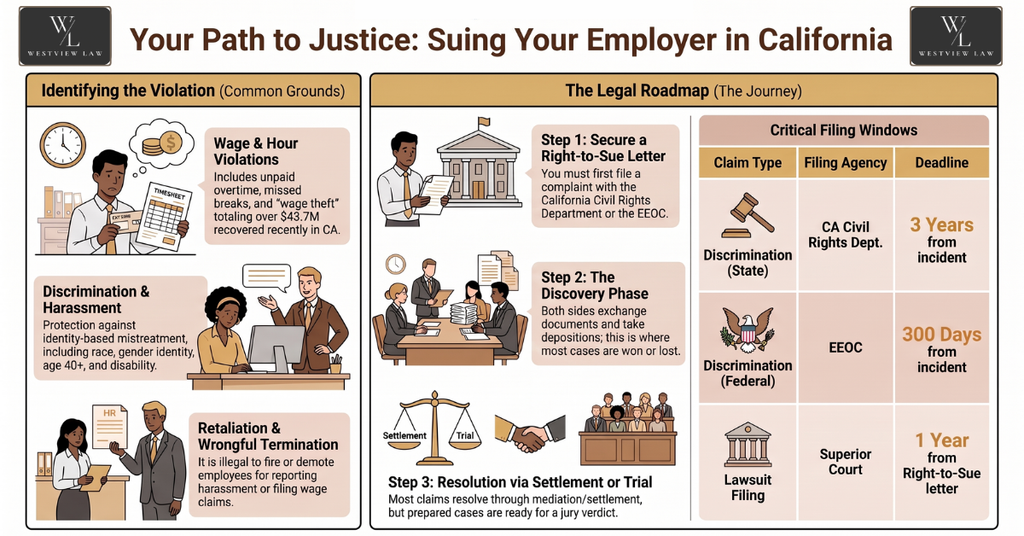
Wage and hour violations round out the list. The numbers here are large. Between January 2022 and August 2025, California's Bureau of Field Enforcement issued nearly 2,100 citations against employers. It recovered stolen and unpaid wages, penalties, and interest totaling more than $43.7 million for workers.
Wage theft covers unpaid overtime, work done off the clock, missed rest periods, illegal payroll deductions, and delayed final paychecks. California adds a penalty of up to thirty days of wages when a departing worker is not paid promptly. Alongside workplace injuries, these claims are often the easiest to prove, because time records and pay stubs either add up or they do not.
How to Assess the Validity of Your Claim in California
Start with what you already have. Offer letters, your employment contract, handbooks, reviews, pay stubs, and written warnings show what your employer said about you before the dispute began.
California employees can request their personnel file and payroll records. Make that request before you resign, because access gets harder afterward. This matters less if you are classified as one of the independent contractors rather than an employee, so sorting out your actual status early on is worth doing too.
Then write things down while you remember them. A short dated entry after each incident, naming who was there and what was said, beats a memory you rebuild a year later. Keep copies of texts and emails. Note which coworkers saw the treatment, since your attorney may later interview witnesses. Be careful what you take with you. Removing confidential files hands the other side an argument that has nothing to do with your case.
The last step is a legal opinion, and it is the one people put off. An employment attorney can tell you whether you have a valid claim, which deadline governs it, and whether an agency filing comes first.
Timing here is unforgiving. You generally have three years to file a Fair Employment and Housing Act complaint with the California Civil Rights Department, then one year from your right-to-sue letter to actually file suit, while a federal EEOC charge is due within 300 days.
How to Sue Your Employer in California

Initiating legal action follows a predictable sequence. Here is how employment disputes usually travel from a first phone call to a resolution.
Step 1: Book an Initial Consultation With an Employment Attorney
Bring your documents, a timeline, and the names of anyone who saw the treatment. Most employee-side firms, ours included, offer it at no cost.
Step 2: File a Complaint With the Appropriate Government Agency
State discrimination and retaliation claims go to the California Civil Rights Department and federal claims to the Equal Employment Opportunity Commission. What you want back is a right-to-sue letter, the legal document that lets you file in court.
Step 3: Preserve Evidence and Send Any Required Notice
Your attorney will tell you what to keep and, in some wage and whistleblower matters, will notify the employer or the state first. Do not delete anything you would rather nobody read.
Step 4: Prepare for Early Mediation or Settlement Discussions
Many employers reach out once counsel is involved, and some agencies offer free mediation first. A documented number for lost wages keeps those settlement negotiations from turning into a fishing trip.
What Is the Legal Process to Sue an Employer in California?
Once your case is ready, your lawsuit gets filed in the appropriate court. Most California employment claims land in state superior court. Federal court comes into play when your claim rests mainly on federal law. The complaint itself lays out the facts, names the laws your employer broke, and spells out what you are asking for.
Next, your employer responds. You can expect a formal answer and often a motion asking the court to narrow or dismiss part of the case. There is no need to panic when that happens, because it is a normal step rather than a sign your case is falling apart.
After that comes the discovery process, and this is the phase where things get real. Both sides exchange documents, answer questions under oath, and sit through depositions. Most cases are won or lost right here, and your employer's own emails usually carry more weight than anything you bring to the table.
Finally, the case wraps up through settlement or trial. Most employment claims settle during or after discovery. The ones that do not go before a judge or jury. If you win, you could recover lost wages and benefits, compensation for emotional distress, punitive damages if the conduct was especially egregious, and attorney's fees paid by your employer.
What Are the Alternative Dispute Resolution Options?

Mediation is the less adversarial route. A neutral mediator, often a retired judge, meets with both sides and works toward a number everyone can live with. Nothing said in that room can be used later if it falls apart. Nobody imposes a decision, so you keep the option to walk away and keep litigating.
Arbitration is a different animal, and many California employees are bound to it without remembering. If you signed an arbitration agreement during onboarding, a private arbitrator may decide your case instead of a jury, with limited discovery and almost no appeal. One carve-out matters. Since March 2022, federal law lets workers with sexual harassment or sexual assault claims go to court regardless of what they signed.
What Are the Advantages of Settling Out of Court?
The practical case for settling is cost and time. A contested employment lawsuit can run one to three years through discovery, motions, and a trial date that moves more than once, while a mediated settlement can close in months. California's Civil Rights Department closed 872 cases through settlement in 2024, securing close to 100 million dollars in relief for workers without a single one of those cases going to trial.
Settlement also gives you control. A verdict is public and binary, while a negotiated agreement lets you shape terms such as a neutral reference, a corrected personnel record, or the timing of payment. California limits how far confidentiality can reach: an employer cannot use a settlement to stop you from discussing unlawful harassment, discrimination, or retaliation, though the amount can stay private.
None of that means you should settle. An early offer is sometimes an attempt to close a case cheaply before discovery exposes what the employer knew, and the leverage that produces fair compensation comes from being genuinely willing to try the case.
What Are the Employment Lawsuit Deadlines in California?
Every claim in this article has its deadline, and missing one can end your case before it starts. Here's how the main filing windows stack up.
| Claim Type | Where You File | Deadline |
|---|---|---|
| Discrimination or harassment (state law) | California Civil Rights Department | 3 years from the incident |
| Discrimination or harassment (after the right-to-sue letter) | Superior court | 1 year from the date on the letter |
| Discrimination or harassment (federal law) | Equal Employment Opportunity Commission | 300 days from the incident |
| Wage and hour violations | Labor Commissioner or court | Varies by claim, generally 3 years |
| Wrongful termination tied to a written contract | Court | Up to 4 years, depending on the contract terms |
How Can an Employment Attorney Help You Sue an Employer in California?
Employment law is a complex process with deadlines that do not forgive a late filing, and the other side will have counsel from the first week. A California employment lawyer finds every claim your facts support and files with the right agency in time. They also value the case against comparable outcomes and take dealing with your former employer off your plate. Getting legal assistance from someone who does this full time can change what you end up recovering.
Here is an illustrative example. A marketing coordinator came to us after being fired three weeks after telling HR that a director kept commenting on her appearance and hinting a promotion depended on drinks after work. She assumed she had no case, since she was at-will and nobody else heard the conversations. Her records said otherwise: her reviews were strong until the week she complained, her replacement had less experience, and HR never opened a written investigation. We filed with the state agency, obtained a right-to-sue letter, and resolved her claims on confidential terms after mediation, avoiding the need for a full civil lawsuit.
Cost remains the final barrier. Organizations representing employees almost always work on contingency, so legal representation does not cost anything up front, and California allows a prevailing employee to recover fees from the employer in most discrimination and wage cases.
Ready to Sue an Employer in California?
Suing your employer starts with understanding two things. First, what the law protects. Second, how little time you may have to act. California gives employees unusually strong rights around pay, breaks, discrimination, harassment, accommodations, and retaliation and backs them with uncapped damages and recoverable fees
If something happened at work that you keep replaying, get an opinion instead of guessing. Talk to an employment attorney and find out where you actually stand.
Wondering if you actually have a case against your employer? Westview Law PC fights exclusively for employees, never companies, and our founder, David M. Safvati, earned Super Lawyers Southern California Rising Stars honors from 2022 through 2024, building a reputation on trial work, not settling to avoid it. Deadlines in California employment cases don't wait around, and every week you sit on this is a week your evidence gets weaker. Contact us today for a complimentary, no‑risk case review before your filing deadline.
Frequently Asked Questions
Here are the questions we hear most often from California employees who are weighing a lawsuit against their employer. Below are the questions we hear most from California employees considering a claim.
What Are the Grounds for Suing My Employer in California?
Common grounds include discrimination or harassment tied to a protected characteristic, wrongful termination, retaliation for protected activity, wage and hour violations, and breach of contract. Unfair treatment alone isn't enough. A specific law has to back the claim.
Can I Sue My Employer if I’m Still Employed There?
Yes, you don't need to quit or get fired first. Retaliating against you for filing a complaint is illegal on its own, so a demotion or sudden write-up afterward can become a separate claim.
Can I Sue My Employer for Wrongful Termination?
You may have grounds to sue in California if your dismissal lacked a legal basis, for example, discrimination, retaliation for reporting unlawful conduct, or denial of protected leave. At-will employment allows termination without cause, but not because of a protected characteristic, a report of unlawful conduct, protected leave, or refusing to break the law.
How Can I Determine if I Have a Valid Legal Claim Against My Employer in California?
You'll want three things: a protected characteristic (race, sex, disability), whistleblowing/retaliation, protected leave (e.g., FMLA/CFRA), or being asked to commit an illegal act. Gather your records and have an employment attorney review them, since a free consultation can clarify more in an hour than weeks of searching on your own.
What Steps Should I Take if I Believe My Employer Has Violated My Rights in California?
If you believe your employer violated your rights in California, begin by submitting a written report to your employer, keeping copies and logging each incident with dates and witnesses. Then, request your personnel records and contact a California employment lawyer as soon as possible, because deadlines begin to run from the date of the conduct.
Disclaimer: This article is general information, not legal advice, and reading it does not create an attorney-client relationship with Westview Law PC. Every outcome depends on its specific facts, so consult a licensed California employment attorney about your situation. The case example above is illustrative and does not describe a specific client matter. Prior results do not guarantee a similar outcome.