

There is no reliable average settlement for a retaliation lawsuit in California, because the state publishes no official figure and the overwhelming majority of settlements are confidential. What a case is actually worth depends on your lost wages, how strong the evidence is, how badly the employer behaved, and which law your claim falls under. Knowing your rights matters here more than any number, because California protections run further than federal ones, and the filing deadlines that apply to you are already running.
Settlement value tracks what the other side believes will happen at trial, which is why Westview Law PC built its practice inside courtrooms rather than around them. Paul S. Marks has litigated for more than 30 years and is a member of the American Board of Trial Advocates. Taylor Markey came to the firm from the U.S. Equal Employment Opportunity Commission, where she served as an Assistant Regional Attorney leading systemic discrimination litigation, so she reads an employer’s defense from the inside. If your employer punished you for speaking up, contact us today for a free case review.
This post covers why no true average exists, what drives the value of a California retaliation claim, what you can recover, what weakens a case, how long these matters take, and how to strengthen yours.
Is There an Average Settlement for Retaliation Lawsuits in California?

California does not publish a single official average or median settlement amount for retaliation lawsuits. No state agency collects and reports that data, and no court does either.
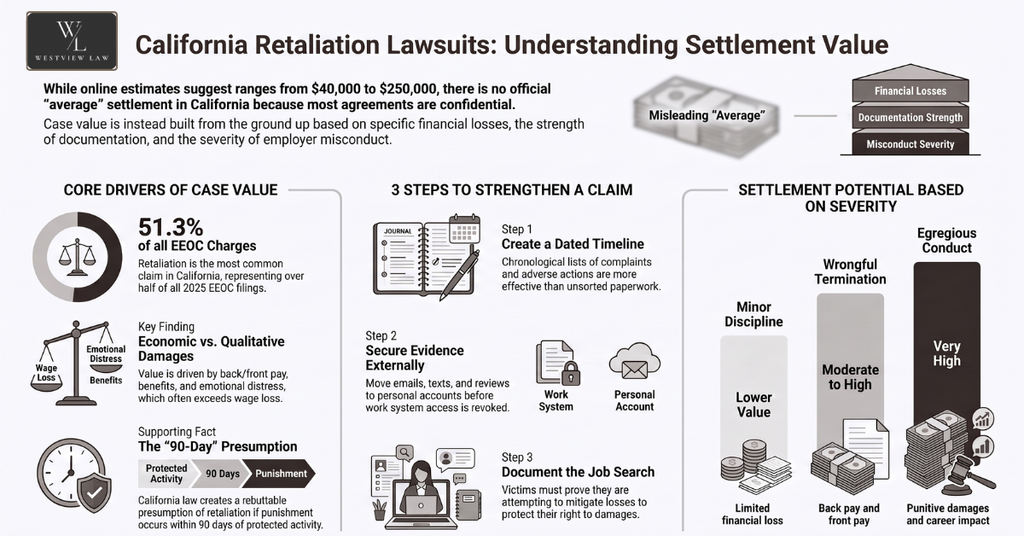
The volume of retaliation charges also helps explain why there is no simple typical case. EEOC data shows that retaliation accounted for 51.3% of all charges filed in California in fiscal year 2025, with 2,259 retaliation charges recorded. Those cases can involve very different underlying conduct, losses, and legal claims, making a single settlement figure particularly misleading.
Most settlements are also confidential. When a retaliation case resolves, the agreement almost always contains a confidentiality clause covering the amount, so the resolved cases that would form any meaningful average never become public in the first place. What does become public tends to be the outliers, the verdicts large enough to make the news, which pulls any informal “average” upward and away from what ordinary cases resolve for.
Retaliation is also not one claim. It covers reporting discrimination or harassment, including sexual harassment or a hostile work environment, making a wage complaint about overtime violations or unlawful wage and hour practices, and whistleblowing on suspected illegal conduct. It also includes raising a safety violation, taking leave protected by the Family and Medical Leave Act, filing a workers’ compensation claim, and other legally protected activity, including concerted activity protected under the National Labor Relations Board’s jurisdiction.
Each of those runs under a different statute, and the statutes provide different remedies. A FEHA retaliation claim carries no damages cap and allows attorney’s fees. A Labor Code section 1102.5 whistleblower claim adds a civil penalty of up to $10,000 per employee per violation.
Whistleblower retaliation settlements may reach $100,000 to $200,000 in cases involving substantial losses, strong evidence, and serious employer misconduct, although there is no reliable California average. A section 132a workers’ compensation retaliation claim works differently again. Two employees with similar facts can end up with very different numbers depending purely on which law fits.
So treat the average settlement figures you find online with real caution. Some online estimates put retaliation lawsuit settlements anywhere from $40,000 to $250,000, but these figures are not official California averages and should not be treated as a prediction of what an individual case is worth.
Most are marketing, extrapolated from a handful of published verdicts or simply invented. A number produced without knowing your wages, your evidence, your employer’s conduct, or your statute tells you nothing about your own case. Anyone who quotes you a figure before reading your documents is guessing.
Typical California Retaliation Settlement Ranges
While no dollar average exists, cases do cluster into recognizable tiers of value. Those tiers are driven by how much money you actually lost, how clearly the evidence ties the punishment to your protected activity, and how far the employer went. Nothing below is a promise about any particular case, and a strong claim in one tier can outperform a weak one in the tier above. The table sets out how these cases generally sort themselves.
| Type of retaliation case | General settlement potential | What can drive the value? |
| Minor retaliation | Lower-value claim | Limited financial loss, minor discipline |
| Demotion or reduced hours | Moderate | Lost wages and benefits |
| Wrongful termination | Moderate to high | Back pay, front pay, emotional distress |
| Strong retaliation with substantial wage loss | High | Clear documentation and significant losses |
| Severe or egregious retaliation | Very high | Punitive damages, severe emotional harm, major career impact |
What Determines How Much a California Retaliation Case Is Worth?
Retaliation is not a fringe workplace claim. In fiscal year 2025, the U.S. Equal Employment Opportunity Commission recorded 2,259 retaliation charges in California, accounting for 51.3% of all EEOC charges filed in the state. That figure does not tell you what an individual case is worth, but it shows how frequently retaliation allegations arise in California workplaces. Value is built from the ground up, out of the specific facts of your case. These are the factors that move it.
1. Lost Wages and Benefits
Back pay is the foundation, covering what you would have earned from the adverse action to the resolution, plus the benefits you lost along the way. Health coverage, bonuses, commissions, and retirement contributions all count, and they add up faster than most people expect.
2. Future Lost Income
Front pay covers what you will lose going forward where returning to the job is not realistic. It matters most for older workers, for specialized roles with few local employers, and for anyone whose industry reputation took the hit alongside the job.
3. Emotional Distress
California allows recovery for the emotional harm retaliation causes, and in FEHA cases this is frequently larger than the wage loss. Emotional distress claims are stronger when supported by evidence such as documented therapy visits, medical records, or testimony about the impact of the retaliation. Treatment records, testimony from people who saw the change in you, and a documented history all make this element concrete rather than abstract.
4. Strength of the Evidence
A case rises or falls on documents, and strong evidence can significantly increase settlement value by making the connection between the protected activity and retaliation easier to prove. Emails showing the complaint, reviews that were strong before and poor after, and an employer’s own written reasons carry far more weight than recollection alone.
5. How Close the Retaliation Was to the Protected Activity
Timing is circumstantial evidence, and tight timing is powerful. California builds it into statute in places, and Labor Code section 98.6 creates a rebuttable presumption of retaliation where an employer punishes an employee within 90 days of protected activity in wage-related cases.
6. How Serious the Employer’s Conduct Was
There is a difference between a supervisor who reacted badly and a company that ran a documented campaign to push someone out. Conduct at the second end of that scale changes both the settlement posture and the damages available.
7. Punitive Damages
Punitive damages are available under Civil Code section 3294 where the employee proves malice, oppression, or fraud by clear and convincing evidence, and a corporate employer generally needs an officer, director, or managing agent involved. They are not automatic, but the realistic possibility of them changes what a defendant will pay to avoid a jury.
8. Attorney Fees and Litigation Costs
FEHA allows a prevailing employee to recover attorney’s fees, as does Labor Code section 1102.5. That shifts the economics considerably, because a defendant facing your legal fees and court costs on top of your damages has a much stronger reason to resolve early. Most employee-side firms also work on a contingency fee basis, so pursuing a claim does not require filing fees out of your own pocket.
What Can You Recover in a California Retaliation Lawsuit?

The money side comes in layers. Back pay covers earnings lost from the adverse action forward, and lost benefits sit alongside it, including health coverage, retirement contributions, and any bonus or commission structure you were cut out of.
Front pay compensates future lost income where reinstatement is not workable. Emotional distress damages are available in FEHA claims and in common law wrongful termination claims, and punitive damages come into play where the employer’s conduct meets the malice, oppression, or fraud standard.
Not all relief is financial. A court can order reinstatement to your position, and it can order removal of negative material from your employment records, which matters more than people realise when the next employer calls for a reference. Other equitable relief is available depending on the claim, including orders requiring an employer to change a policy or practice.
Certain retaliation lawsuits carry statutory penalties on top. Labor Code section 1102.5 allows a civil penalty of up to $10,000 per employee per violation, payable to the employee. And where the statute authorizes it, as FEHA and section 1102.5 both do, your attorney’s fees and costs are recoverable from the employer rather than out of your recovery.
Example: How a California Retaliation Settlement Could Be Calculated
Suppose an employee earning $90,000 a year reports unlawful conduct at work and is terminated shortly afterwards. She stays unemployed for six months, losing roughly $45,000 in wages and benefits. She kept the emails documenting her complaint, and two coworkers saw how the employer reacted.
It would be a mistake to treat that $45,000 as the settlement value. Economic loss is the starting point of the analysis, not the end of it. The same file also has to be weighed for the strength of the retaliation evidence, future wage loss if her earning capacity took a lasting hit, emotional distress, how the employer behaved, and whether the facts open the door to punitive damages.
Then come the practical factors that shape every negotiation. Litigation risk cuts both ways, since a jury may see the employer’s version. Cost matters, because a case that runs two years costs both sides real money. So does the time value of resolving now against a trial date well into the future. A settlement figure is what those elements produce together, which is exactly why a number pulled off a website cannot tell you what your own claim is worth.
What Can Reduce the Value of a Retaliation Claim?
Plenty of things pull value down, and most articles skip this part. The biggest is simple: little or no financial loss. An employee who was written up but kept their job and their pay has a real claim in principle and a modest one in dollars, because there are few wages to recover.
Evidence problems come next. Weak evidence, no witnesses, or a complaint that was only ever made verbally leaves you arguing recollection against documentation. A long gap between the protected activity and the adverse action hurts too, because timing is what usually supplies the causal link, and six months of nothing in between gives the employer room to argue the two are unrelated. Failing to preserve evidence causes avoidable damage, particularly where the material lived on a work device you lost access to.
The employer’s own record matters just as much. Legitimate, documented performance problems predating your complaint are the most effective defense there is, especially where the file shows warnings that started before you ever spoke up.
An employer with strong evidence of an independent reason for the termination, such as a documented restructure affecting several employees, can make causation genuinely difficult. Inconsistent accounts from the employee compound all of it, since a story that changes between an HR complaint, an agency filing, and a deposition gives the defense something to work with.
Finally, deadlines. Miss the filing deadline that applies to your claim, and the value goes to zero regardless of the merits. The clocks differ by statute, and they do not run together. An FEHA administrative complaint with the Civil Rights Department must be filed within three years, then suit within one year of the right-to-sue notice, while a Section 1102.5 whistleblower claim runs on a three-year limitation period and a common law wrongful termination claim in violation of public policy runs on two.
How Long Does a California Retaliation Lawsuit Take to Settle?

There is no guaranteed timeline, and anyone who offers one is guessing. The progression is reasonably consistent, though. The retaliation happens, evidence gets collected, and an administrative claim may be filed. The employer responds, an investigation or litigation follows, settlement negotiations open, and the matter either resolves, goes to mediation, or heads for trial.
Which law applies changes the shape of that path considerably. A FEHA claim requires you to go through the California Civil Rights Department first and obtain a right-to-sue notice before filing suit. Where federal law applies, an employee may also need to file a formal complaint with the EEOC, and the applicable deadline depends on the type of claim and circumstances.
A Labor Code section 1102.5 whistleblower claim generally does not require exhausting an agency process at all, so it can move to court sooner. Wage-related retaliation can go through the Labor Commissioner’s Office, which investigates directly and can order reinstatement and back pay.
Beyond the statute, the timeline turns on the ordinary realities of litigation. Cases resolve faster where the documents are clean and both sides can see the same picture early. They stretch where discovery is contested, where the employer disputes causation, or where the court’s calendar pushes a trial date out.
Many cases settle at mediation, which often happens after the key depositions rather than before, because that is the point at which both sides can price the risk. Many retaliation claims resolve through negotiation or mediation within 6 to 18 months, although cases involving disputed evidence or lengthy litigation can take considerably longer.
How to Strengthen Your California Retaliation Claim
What you do in the first few weeks tends to decide what the claim is worth later. These five steps do most of the work.
Step 1: Create a Timeline
Write down the protected complaint, who received it, what happened afterwards, and the dates of every disciplinary action or other adverse action, including the termination. A single page in date order does more for a first consultation than a box of unsorted paperwork.
Step 2: Preserve Evidence
Save emails, texts, performance reviews, HR communications, pay records, schedules, and the policies your employer says you broke. Move all of it to a personal account rather than a work device, because system access usually disappears the day you do.
Step 3: Identify Witnesses
Keep a list of coworkers who saw or heard anything relevant, including the meeting where you complained and the conversations that followed. Note what each person witnessed while it is fresh, since memories fade and people leave the company.
Step 4: Document Financial Losses
Track lost wages, lost benefits, and any other employment-related financial loss, and keep a record of your job-search efforts. That search record matters because you have a duty to mitigate, and an employer will argue your losses down if it looks like you did not try. If a victim does not actively search for a new job following retaliation, they may face reduced damages because of the duty to mitigate their losses.
Step 5: Get Legal Advice Before Accepting a Settlement
A first offer is priced on what the employer knows and what it thinks you can prove, which is rarely the full picture of your claim. Have the evidence and the damages reviewed before you sign, because a release ends the matter permanently.
Talk to a California Employment Lawyer About Your Retaliation Case
There is no published average settlement for a California retaliation lawsuit, and there cannot be a meaningful one while most settlements stay confidential and the claims arise under different statutes with different remedies. Value comes from lost wages and benefits, future income, emotional distress, the strength of the evidence, how close the retaliation sat to the protected activity, and how far the employer went.
Weak evidence, small financial loss, documented performance problems, or a missed deadline pull it back down. Settlement value is highly fact-specific, which is why the useful step is having someone read your actual documents. Deadlines apply, they differ by statute, and they run whether or not you are ready. Get your evidence and your potential damages reviewed before one of them closes.
Westview Law PC represents employees throughout California, from its Century City office out to San Diego, Oakland, and Fresno. Founder David Safvati was named to Super Lawyers’ Southern California Rising Stars from 2022 through 2024 and earned a place on Best of the Bar’s Top 100 Verdicts in California in 2024. The firm handles retaliation, wrongful termination, discrimination, age discrimination, and wage claims for workers rather than employers on a contingency fee basis. Bring your timeline, your documents, and your pay records to us for a free case evaluation today.
Frequently Asked Questions
These questions come up often when employees are considering a workplace retaliation claim in California. The value of a claim depends on the legal framework, the employer's actions, the employee's losses, and the evidence available.
What Is the Average Settlement for a Retaliation Lawsuit in California?
There is no reliable average because settlements are usually confidential and employer retaliation claims arise under different laws. While some cases settle for tens of thousands of dollars, significant settlements can occur when there are substantial losses or egregious employer misconduct.
How Much Is a Retaliation Lawsuit Worth in California?
A claim's value may include economic damages, lost wages, benefits, and emotional distress, depending on the applicable law and facts. The courts assess available retaliation damages based on the evidence, the adverse employment action, and the employer's conduct. FEHA claims carry no damages cap, unlike federal claims under Title VII of the Civil Rights Act, where compensatory and punitive damages are capped between $50,000 and $300,000 by employer size.
Can I Get Compensation if I Was Fired for Reporting My Employer?
Yes, if you can prove retaliation and show that the employer retaliated because you engaged in legally protected activity. Depending on the claim, monetary compensation may include back pay, front pay, emotional distress damages, punitive damages, and attorney's fees.
Can I Sue for Retaliation Without Being Fired?
Yes, a workplace retaliation case does not always require termination. An adverse employment action can include discipline, reduced hours, demotion, or other conduct that causes work-related harm when connected to protected activity.
How Long Do I Have to File a Retaliation Claim in California?
The deadline depends on the statute governing your claim, so employees should seek legal guidance early. For FEHA claims, a CRD complaint generally must be filed within three years of the alleged unlawful practice, while whistleblower retaliation cases and other claims may have different deadlines.
Should I Accept a Retaliation Settlement?
Before accepting an offer, consider whether it provides a fair settlement for your losses and releases your legal rights. An employment attorney or experienced legal representation from a law firm can review the offer, evidence, and potential legal action before you decide.